The Transistor: an Electric Switch
transistors. point-contact transistor. what is a transistor. who invented the transistor. when was the transistor invented. why is the transistor important for computers. how many transistors are in a computer chip
🕰 1947 · ⏱ 6 min read
In one sentence: In December 1947, scientists at Bell Labs made the first transistor: a tiny solid part that controls electricity, and that later replaced the large, hot vacuum tubes in computers.
The world before
In the 1940s, the first electronic computers, like ENIAC and Vacuum Tubes, were built from vacuum tubes. A vacuum tube is a part that can control a flow of electricity. Computers used tubes to make switches that could be turned on and off, and on or off is exactly what a Bit needs.
But vacuum tubes had serious problems. They used a lot of power, they produced a lot of heat, and they took up a lot of space. They also burned out and had to be replaced. ENIAC used about 18,000 tubes, and keeping them working reliably was the biggest challenge of running it.
Computers were not the only users of tubes. The Bell Telephone System in the United States used vacuum tubes to make telephone signals stronger. Its telephone switches used relays: electric switches with moving parts. The telephone company had its own research center, called Bell Labs. Bell Labs wanted to replace the tubes and the relays with something more reliable.
What happened
At Bell Labs, a group of scientists studied semiconductors: a group of materials that includes silicon and germanium. The scientists hoped they could control how much electricity flows through a semiconductor. If they could, a small solid piece of it might do the work of a vacuum tube.
The group was led by William Shockley and Stanley Morgan. Two members of the group, John Bardeen and Walter Brattain, did the key experiments. Their most intense period of work was from November 17 to December 23, 1947. This period is often called the "Miracle Month".
They used a small, flat piece of very pure germanium, a type of semiconductor. They pressed two gold contacts onto it, very close together, held in place by a small plastic wedge. On December 16, 1947, their experiment worked. A weak electrical signal (a small, changing flow of electricity, such as a telephone signal) went into the device. It came out stronger. This was the first working transistor. The Computer History Museum says the device could make a signal up to 100 times stronger. This first kind is called a point-contact transistor: its gold contacts touch the germanium at tiny points.
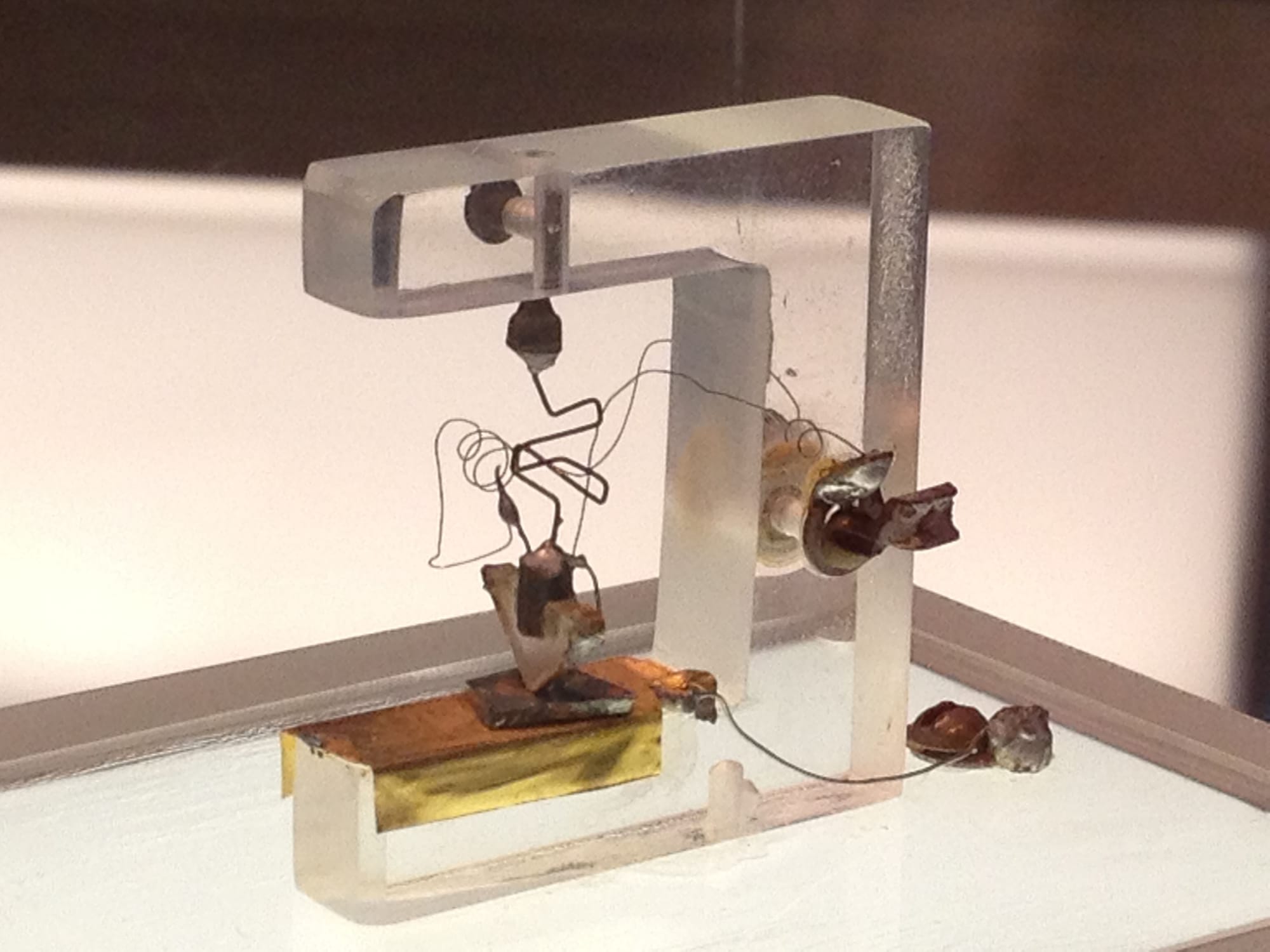 WedgeGermaniumClose-up: the tip of the plastic wedge presses the two gold contacts onto the germanium

About six months later, on June 30, 1948, Bell Labs announced the transistor to the public at a press conference in New York.
In 1956, Bardeen, Brattain and Shockley received the Nobel Prize in Physics for this work.
Why it mattered
Why does "making a signal stronger" matter for computers? Think of a water tap. A small movement of your hand controls a large flow of water. You can open the tap a little or a lot. Or you can turn it fully open or fully closed.
A transistor works the same way, with electricity: a small electrical signal controls a larger flow of electricity. That gives it two uses:
- Amplifying: a weak signal controls a strong flow, so the signal comes out stronger.
- Switching: the small signal turns the large flow fully on or fully off. On or off is a bit.
Modern computer circuits use transistors as switches. Many switches working together can store bits and work with them. You will see how in later lessons.
(Where the tap comparison breaks down: you turn a tap with your hand. In a transistor, electricity controls electricity. In the first transistor, the signal on one gold contact controlled the flow of electricity through the other.)
Compared to a vacuum tube, a transistor has big advantages:
- It is much smaller.
- It uses much less power.
- It works immediately: a tube had to warm up first.
The first transistors were delicate, and turning them into a product was hard. But engineers improved them, and many thousands were made. In the late 1950s, computers began to use transistors instead of tubes. IBM began designing one of its first transistor computers, called Stretch, in the mid-1950s.
Later, engineers found a way to put many transistors on one thin, flat piece of semiconductor. That invention is the The Integrated Circuit, also called a chip. It is the next step in this story.
Today, transistors are so small that a single chip can hold billions of them. For example, Apple's M4 chip, announced in 2024, contains 28 billion transistors. In a computer chip, most of them work as tiny switches.
🔍 See it for yourself
- The Computer History Museum has a page about the first transistor, with photos and a short history: https://www.computerhistory.org/siliconengine/invention-of-the-point-contact-transistor/ Look for the photo with the caption "Bardeen and Brattain's first point-contact transistor".
- The American Physical Society tells the story of the "Miracle Month". It is a longer article: read the parts about Bardeen and Brattain's experiments: https://www.aps.org/apsnews/2000/11/this-month-in-physics-history
Then look at the device you are reading this on. Somewhere inside it is a chip with millions or billions of transistors.
Recap
- The first electronic computers used vacuum tubes as switches. Tubes were big, hot, used a lot of power and failed often.
- On December 16, 1947, Bardeen and Brattain at Bell Labs made the first transistor from germanium.
- A transistor uses a small signal to control a larger flow of electricity, so it can work as a switch. Modern computer chips can contain billions of them.
Sources
- Computer History Museum, The Silicon Engine, 1947: Invention of the Point-Contact Transistor: https://www.computerhistory.org/siliconengine/invention-of-the-point-contact-transistor/
- American Physical Society, This Month in Physics History, November 17 – December 23, 1947: https://www.aps.org/apsnews/2000/11/this-month-in-physics-history
- Penn Engineering, Celebrating Penn Engineering History: ENIAC: https://www.engineering.upenn.edu/about/history-heritage/eniac/
- Engineering and Technology History Wiki, Bell Demonstrates Transistor: https://ethw.org/Bell_Demonstrates_Transistor
- W. Buchholz, "The word 'byte' comes of age...", BYTE, February 1977: https://archive.computerhistory.org/resources/access/text/2016/12/102762489-05-01-acc.pdf
- Apple Newsroom, Apple introduces M4 chip (May 2024): https://www.apple.com/newsroom/2024/05/apple-introduces-m4-chip/
- Jim Lesurf, University of St Andrews, The First Eleven, Part 11, Page 4: https://www.st-andrews.ac.uk/~www_pa/Scots_Guide/first11/part11/page4.html
- Computer History Museum, Revolution, How Do Digital Computers "Think"?: https://www.computerhistory.org/revolution/digital-logic/12/269
- Wikipedia, Integrated circuit: https://en.wikipedia.org/wiki/Integrated_circuit
Written with AI · Reviewed by AI · Not yet checked by a human
Found a mistake, or something you did not understand? Report a problem.