The Telegraph and the Telephone
telegraph. electric telegraph. telephone. Morse code. What hath God wrought. telephone switchboard. telephone operator. what was the telegraph. how did the telegraph work. what is morse code. who invented the telephone. how did the first telephone work. what do the telegraph and telephone have to do with the internet
🕰 1800s · ⏱ 7 min read
In one sentence: In 1844 Samuel Morse sent a telegraph message from Washington to Baltimore as pulses of electric current, and in 1876 Alexander Graham Bell's telephone carried a human voice over a wire.
The world before
A history page about Morse's 1844 telegraph line says that before it, communication was limited to "the speed of horse travel". (There was at least one faster way. From 1794, France had a line of signal stations that passed messages by sight, from Paris to Lille.)
In the 1800s, inventors tried to use electricity instead. From Electricity Basics: Current, Voltage, On and Off you know that current flows around a closed loop called a circuit, and that a switch opens or closes the loop. So if you close a switch in one city, current can flow in a wire that reaches another city.
What happened
The telegraph (1837–1844)
A telegraph is a machine that sends messages over a wire as pulses of electric current. Inventors in more than one country worked on it. In Britain, William Fothergill Cooke and Charles Wheatstone received a patent for an electric telegraph in June 1837. (A patent is an official document from a government. For some years, it lets the inventor stop other people from making or selling the invention.)
In the United States, Samuel F. B. Morse was "an American painter and inventor". His assistant, Alfred Vail, was a skilled mechanic. In January 1838, Morse and Vail showed their telegraph working over two miles (about 3 km) of wire. In 1843, the United States Congress (the group that makes the country's laws) gave Morse $30,000 to build an experimental line between Washington and Baltimore.
On May 24, 1844, Morse was in the Capitol, the building where Congress meets in Washington. He sent a message over the new line to Vail in Baltimore. The message was "What hath God wrought". In today's English, these old words mean "What has God done!"
How the telegraph worked
The telegraph was a circuit with a very long wire:
- At the sending end, an operator tapped a telegraph key. The key is a switch. Each tap closed the circuit, and current from a battery flowed down the line.
- At the receiving end, the current flowed through an electromagnet: a coil of wire that acts as a magnet while current flows through it.
- The magnet pulled a small metal arm. Morse's early receiver used it to mark dots and dashes on a strip of paper. A later receiver, the sounder, made clicking sounds instead, and the operator listened to them.
Diagram: a simplified telegraph line. In Washington, pressing the key (a switch) lets a battery push current through a long wire to Baltimore. There, the current reaches an electromagnet, which pulls an arm to mark a dot or a dash. Releasing the key stops the current.
   Washington                                              Baltimore

  [key] ---- [battery] ------------ long wire ------------ [electromagnet]
   press = current flows                                    pulls the arm:
   release = current stops                                  dot or dash
Like every circuit, the telegraph needed a closed loop, so the current also had a path back. The diagram leaves that return path out.
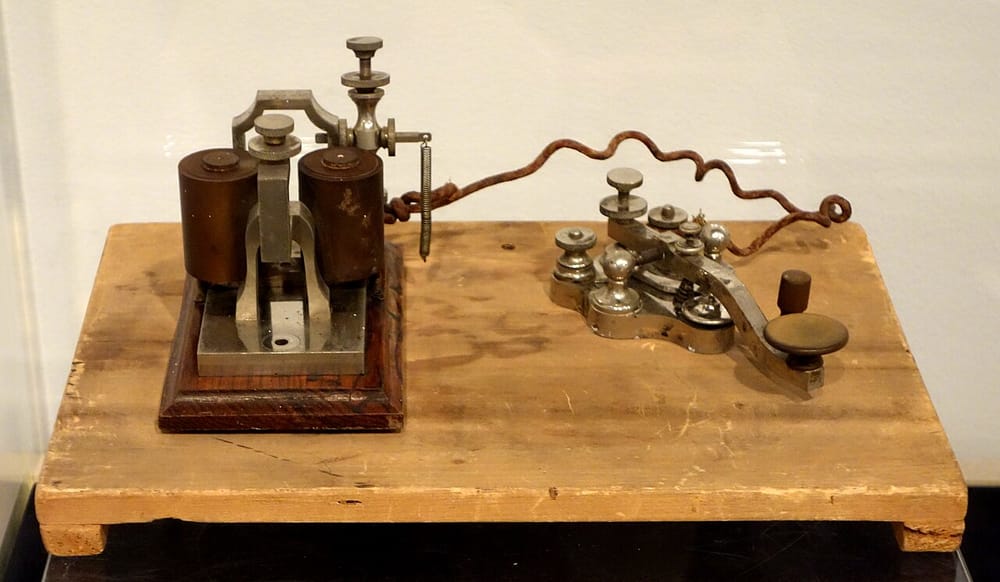 ElectromagnetSounderKey

A short press made a dot. A longer press made a dash. Groups of dots and dashes stood for letters. This system is called Morse code. (Some people think Vail created the code. Others say Morse created it.)
Telegraph lines spread. In the United States they grew along with the railroads. In 1866, a cable under the Atlantic Ocean, from Ireland to Newfoundland, made a permanent telegraph link between Europe and North America. By 1875, the Western Union company had 250,000 miles (about 400,000 km) of telegraph wire. That year, Americans sent 17 million messages over its lines.
The telephone (1876)
The telegraph could send only pulses: current on, or current off. Alexander Graham Bell wanted to send a human voice. Bell was born in Scotland in 1847. He moved to Boston, in the United States, to teach deaf students. He knew that speech is made of complex, continuous waves of sound. (Sound is a vibration of the air.)
His idea was to make the current change smoothly, in the same shape as the sound. In Bell's telephone, the vibrations of a voice made the current in the wire rise and fall in the same pattern. At the other end, the changing current was turned back into sound.
Bell asked for his patent on February 14, 1876, and it was given to him on March 7, 1876. Its title was "Improvement in Telegraphy". On the same day, another inventor, Elisha Gray, sent papers to the patent office about a speaking telephone. Courts later decided the patent battles in Bell's favour. On March 10, 1876, in Boston, Bell spoke to his laboratory assistant, Thomas Watson, through the new machine: "Mr. Watson, come here! I want to see you."
Connecting many telephones
Telephone lines were joined at a central place called an exchange. There, people called operators connected calls by hand. They plugged cords into sockets on a board called a switchboard, to join the caller's line to the line being called. The cord joined the two lines into one path for that call. By the late 1940s, automatic machines were replacing the human operators.
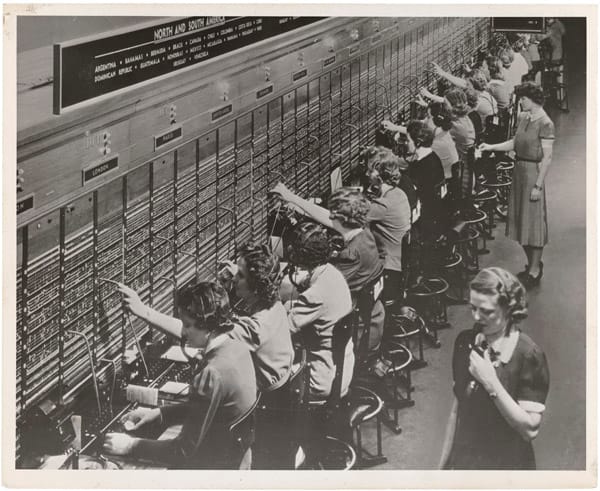 SocketsCordsOperator

Why it mattered
The telegraph and the telephone lines were networks: many places joined by wires, sending messages to each other using electricity. Messages could now travel long distances almost instantly.
Later, computers used these same lines. The Computer History Museum says: "Until the 1960s, computers mostly used phone and telegraph equipment to communicate."
But the telephone network had a weakness. During a call, the signal travels over one particular path. The museum explains: "If it is blocked, nothing gets through. And when nothing is being said, the line is wasted." Starting in the early 1960s, researchers proposed a different way: cut messages into small pieces called Packets, which can take different paths. This idea was used in ARPANET, an early computer network you will meet soon.
🔍 See it for yourself
- Open the IEEE History Center page The Telephonic Bell. Scroll down until you see a handwritten notebook page with the caption "Alexander Graham Bell's Notebook Entry for March 10, 1876". It records the day Bell said "Mr. Watson, come here! I want to see you." The old handwriting is hard to read, so do not worry if you cannot read every word.
- Open the Computer History Museum's Telephone switching office page. You will see a photo of telephone switching equipment. Its caption says that by the late 1940s, automatic machines were replacing human operators.
Recap
- On May 24, 1844, Samuel Morse sent "What hath God wrought" by telegraph from Washington to Baltimore. The telegraph sent pulses of current, and Morse code turned dots and dashes into letters.
- In 1876, Alexander Graham Bell's telephone carried a voice over a wire by making the current rise and fall like the sound waves.
- Telephone lines were joined at exchanges. Until the 1960s, computers mostly used these lines to communicate. Their weaknesses led researchers to propose a different way: packets.
Sources
- Linda Hall Library, Scientist of the Day: Samuel F. B. Morse: https://www.lindahall.org/about/news/scientist-of-the-day/samuel-f-b-morse/
- Smithsonian, The Civil War: Mathew Brady portrait of Samuel F. B. Morse: https://civilwar.si.edu/brady_morse.html
- Mall History, Samuel Morse sends first telegraph message from the US Capitol: https://mallhistory.org/items/show/176
- Engineering and Technology History Wiki, Milestones: Demonstration of Practical Telegraphy, 1838: https://ethw.org/Milestones:Demonstration_of_Practical_Telegraphy,_1838
- Engineering and Technology History Wiki, France Builds Visual Telegraph: https://ethw.org/France_Builds_Visual_Telegraph
- USPTO, Patent essentials: https://www.uspto.gov/patents/basics/essentials
- Bible Study Tools, Compare translations of Numbers 23:23: https://www.biblestudytools.com/numbers/23-23-compare.html
- Engineering and Technology History Wiki, Bell Files Telephone Patent: https://ethw.org/Bell_Files_Telephone_Patent
- Engineering and Technology History Wiki, William Fothergill Cooke: https://ethw.org/William_Fothergill_Cooke
- Adams County Museum, Electrical Telegraph Sounder: https://www.adamscountymuseum.com/cultural-center-1/electrical-telegraph-sounder
- Engineering and Technology History Wiki, Milestones: Landing of the Transatlantic Cable, 1866: https://ethw.org/Milestones:Landing_of_the_Transatlantic_Cable,_1866
- IEEE History Center, The Telephonic Bell: https://history.ieee.org/programs/ieee-global-museum/the-telephonic-bell/
- Engineering and Technology History Wiki, Milestones: First Intelligible Voice Transmission over Electric Wire, 1876: https://ethw.org/Milestones:First_Intelligible_Voice_Transmission_over_Electric_Wire,_1876
- A. G. Bell, US Patent 174,465, Improvement in Telegraphy: https://patents.google.com/patent/US174465A/en
- Science Museum Group Collection, telephone switchboard: https://collection.sciencemuseumgroup.org.uk/objects/co33337
- Computer History Museum, Revolution: Telephone switching office: https://www.computerhistory.org/revolution/networking/19/371/2178
- Computer History Museum, Revolution: Connecting Over Phone Lines: https://www.computerhistory.org/revolution/networking/19/371
- Computer History Museum, Revolution: Connections: Global Networks: https://www.computerhistory.org/revolution/networking/19/374
- Computer History Museum, Revolution: Networking Takes Off: https://www.computerhistory.org/revolution/networking/19/407
Written with AI · Reviewed by AI · Not yet checked by a human
Found a mistake, or something you did not understand? Report a problem.